Turmeric Tea and Inflammation: Does It Work, and How to Boost Absorption
- craig2500
- 1 hour ago
- 5 min read

Turmeric tea can measurably ease inflammation, largely because of curcumin, the compound that gives turmeric its color. But a cup of tea delivers far less curcumin than the capsules used in most clinical trials, so it's realistic to expect steady, modest relief with daily use rather than the dramatic results reported in studies that dosed people with concentrated extract.
That gap between "the study" and "your mug" is the part most turmeric tea guides skip. It matters because raw curcumin is poorly absorbed on its own. Your gut and liver break most of it down before it ever reaches your joints, which is why the same active ingredient that produces strong results in a lab can feel like it's doing very little in a weak, unseasoned tea.
The upside: two cheap additions, black pepper and a small amount of fat, meaningfully close that gap, and there's actual research behind both. Below is what the evidence says about turmeric tea specifically, why it under-delivers without help, and how to fix that.
What the Research Actually Shows
Curcumin's anti-inflammatory effect isn't folklore. In a clinical study on osteoarthritis discussed by Harvard Health Publishing, 94% of participants taking curcumin reported at least a 50% improvement in pain and inflammation symptoms. A separate randomized trial published in the journal Trials (Shep et al., 2019) compared curcumin directly against diclofenac, a standard prescription anti-inflammatory: none of the curcumin group reported stomach-related side effects, compared with 28% of the diclofenac group.
Those results come from concentrated curcumin supplements, not a cup of tea. Turmeric itself is only a few percent curcumin by weight, and steeping loose or bagged turmeric releases even less of that into the water than a standardized extract does. So while the mechanism is real, treat turmeric tea as a lower, slower dose of the same thing, not a swap for a supplement or a prescribed medication.
Clinical reviews have also linked curcumin supplementation to reductions in inflammatory blood markers such as C-reactive protein (CRP, a liver protein that rises when the body is fighting inflammation) and IL-6 (a signaling molecule that drives that inflammatory response). Tea won't move those markers as fast as a supplement dose would, but consistent daily intake over weeks, not days, is where people report noticing a difference.
Why a Cup of Tea Alone Under-Delivers
This is the part worth understanding before you brew your first cup: curcumin is fat-soluble and gets flagged for rapid breakdown by your liver and intestines almost as soon as it's absorbed. On its own, very little of it reaches your bloodstream intact. That's true whether the curcumin comes from a premium supplement or a box of tea bags. It's a property of the molecule, not the product.
If you've made turmeric tea from loose powder rather than bags, you've probably already run into the practical side of this: the powder doesn't fully dissolve, it settles into a gritty layer at the bottom of the cup, and it stains a white mug or countertop if you wipe it up dry instead of rinsing right away. None of that affects the tea's effectiveness, but it's the kind of detail that explains why most people find bagged blends easier to live with day to day.
Two Additions That Change How Much You Actually Absorb
Black pepper. Black pepper contains piperine, the compound responsible for its bite. A study in Planta Medica (Shoba et al., 1998) found that adding piperine to curcumin increased its bioavailability, meaning the amount that actually reaches your bloodstream, by up to 2,000%. A pinch is enough; piperine's effect doesn't scale much further with larger amounts, so dumping in a teaspoon just makes the tea taste like broth without adding benefit.
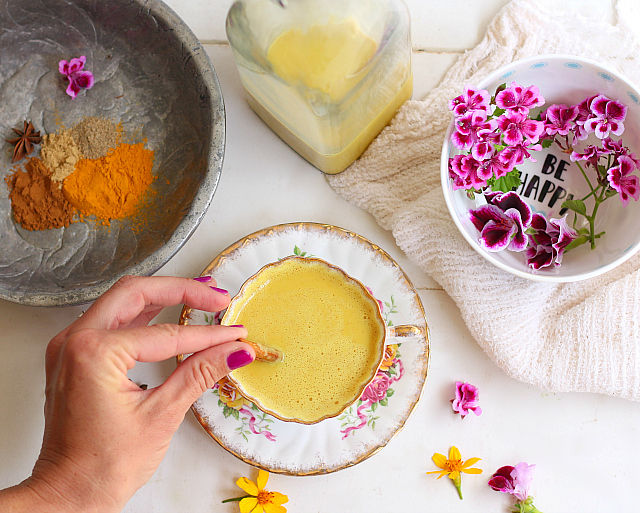
Healthy fat. Because curcumin is fat-soluble, it binds to fat molecules more readily than it dissolves in water. A splash of warm milk, a spoonful of coconut oil, or a small amount of ghee stirred into the tea gives it something to bind to on the way through your digestive system. This is also why golden milk, a turmeric tea variant made with milk, tends to outperform a plain water-based brew for absorption even before pepper is added.
Combine both and you're addressing the two separate reasons raw curcumin underperforms: rapid breakdown, which pepper slows, and poor solubility, which fat corrects. Neither fix costs anything beyond what's already in most kitchens.
What Else Turmeric Tea Does
Inflammation is the headline reason people search for turmeric tea, but the same cup provides a few other things worth knowing about, even though the tea-strength dose is again lower than what's used in the underlying research.
Benefit | What's behind it | Source |
Mood support | Curcumin is linked to higher serotonin and dopamine activity, both mood-regulating neurotransmitters | 2008 study on curcumin and monoamine levels |
Metabolic support | Associated with improved fasting blood glucose and reduced insulin resistance in review studies | PubMed Central clinical reviews |
Trace minerals | A 3g serving of dried turmeric (roughly one to two cups of tea) provides an estimated 26% of the daily value for manganese, 9% for iron, and 4% for copper | Nutrient composition data for dried turmeric |
Low calorie count | Unsweetened turmeric tea runs about 10-30 calories per cup | Standard nutritional estimate |
Caffeine-free | No caffeine, so it's suitable in the evening without disrupting sleep | N/A |
The mood and metabolic findings come from broader curcumin research, not turmeric tea specifically, so treat them the way you'd treat the inflammation research: real signal, smaller effect at tea-strength doses, more noticeable with consistent daily use over time.
Picking a Turmeric Tea That Actually Delivers
Not every box on the shelf is built to solve the absorption problem described above. A few checks before you buy: look at the ingredient list for black pepper extract or piperine listed by name, since a blend without it is relying on curcumin absorbing on its own, which it doesn't do well. Confirm no caffeine is listed; turmeric itself is naturally caffeine-free, so caffeine on the label means it's been blended with black or green tea, which changes when you'd want to drink it. Ginger, cinnamon, or cardamom in the blend aren't just flavor decisions, they round out turmeric's earthy, slightly bitter edge, which is the main reason people give up on turmeric tea after one cup. A USDA organic certification (or equivalent) is the fastest way to rule out fillers or unlisted additives without reading a lab report.
Shea's Apothecary Organic Turmeric Spice Tea
Shea's Apothecary's Organic Turmeric Spice Tea blends organic turmeric, ginger, and cinnamon specifically to soften turmeric's natural bitterness, since that's the main reason people stop drinking it after the first box. It's caffeine-free, so it works as an evening cup without affecting sleep.
The tea bags themselves are made from Manila hemp fiber (a plant fiber valued for its strength and heat tolerance during steeping), with no dyes, glue, or added adhesives, and the paper is oxygen-bleached rather than chlorine-bleached. The blend is free of GMOs and common allergens.
FAQs
Does turmeric tea help reduce inflammation?
Yes. Curcumin, turmeric's active compound, has documented anti-inflammatory activity in clinical research. A cup of tea delivers a much smaller dose than the supplements used in most studies, so expect gradual improvement with daily use rather than the fast results seen in trials using concentrated extract.
What should I add to turmeric tea for better absorption?
A pinch of black pepper for the piperine, plus a small amount of fat such as warm milk, coconut oil, or ghee. Together they address the two main reasons curcumin is poorly absorbed on its own.
Can I drink turmeric tea every day?
Yes, for most people. One to two cups daily is a common, well-tolerated amount. People with gallstones or on blood-thinning medication should check with a doctor first, since curcumin can affect bile production and blood clotting.


Comments